REQUEST FOR PROPOSAL
Strategic vendor partnership opportunity for senior living facilities, correctional facilities, remote clinics, and other mobility-limited care settings
Physician-led teleophthalmology + AI-assisted workflow
June 23rd, 2026
RFP at a Glance
Purpose
Identify equipment vendors and strategic partners who can help build, support, and scale a portable ophthalmology data-collection kit.
Target settings
Senior living, prisons and jails, remote/rural clinics, nursing homes, mobile clinics, and other sites where travel is a barrier.
Budget target
Planning estimate: approximately $30,000 – $40,000 per comprehensive kit. Vendor quotes and service terms must confirm final pricing.
Clinical model
Local staff collect standardized data. MyEyesAI supports triage and workflow. A licensed ophthalmologist remains the clinical decision-maker.
Please indicate interest by August 27th, 2026
Contact: Rohit Mahajan, CEO and Co-Founder, info@myeyesai.com
1. Executive Summary
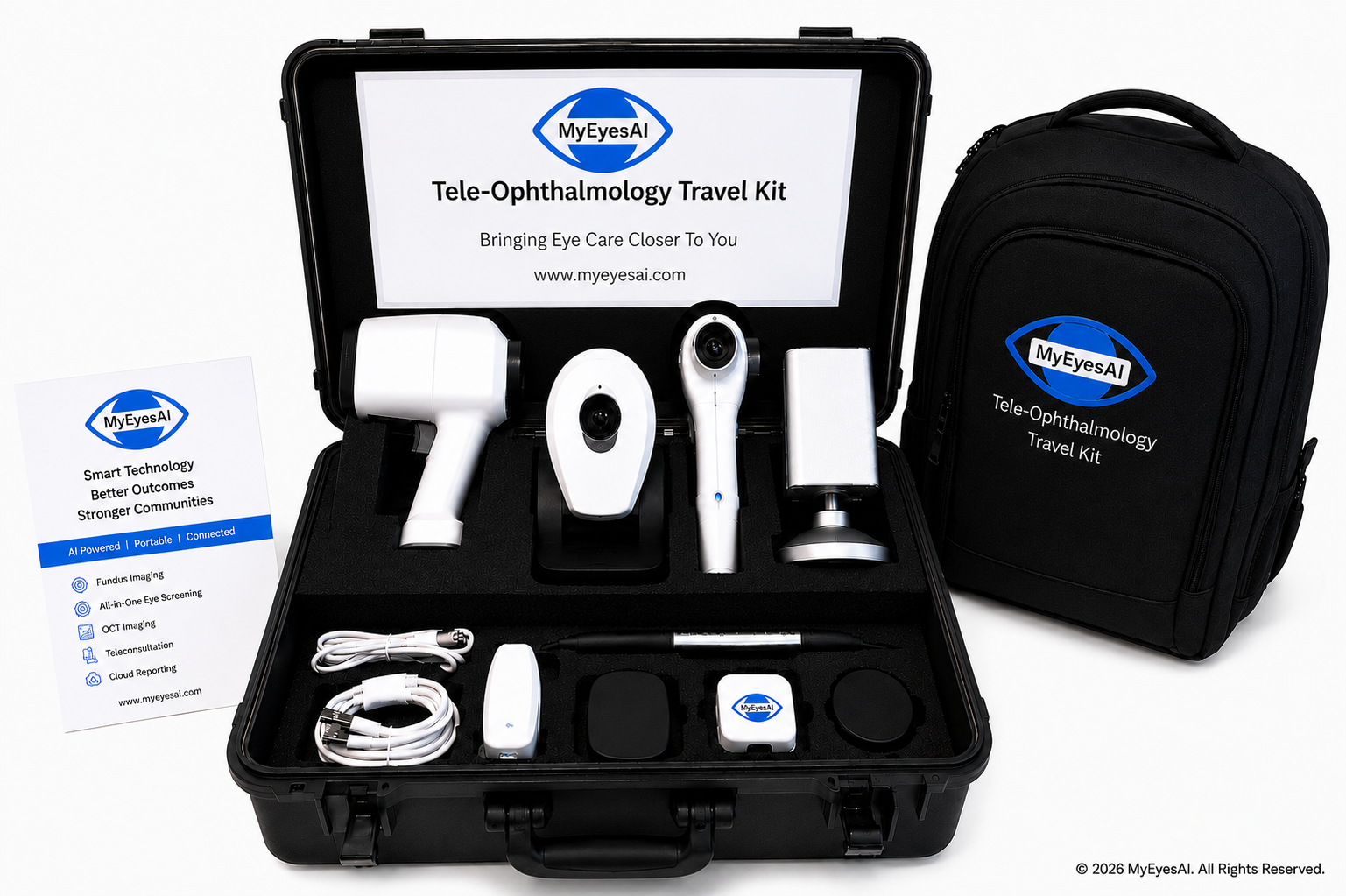
MyEyesAI is seeking proposals from equipment manufacturers, distributors, integrators, and strategic partners to assemble and support a portable teleophthalmology equipment kit. The kit will allow trained onsite staff to collect ophthalmic data from patients who cannot easily travel to an eye specialist. MyEyesAI will organize the intake, imaging, testing, urgency scoring, and care-plan support so that a remote ophthalmologist can review the case and make the clinical decision.
This is not a request for a random box of devices. MyEyesAI is looking for partners who understand real-world care delivery, can support multi-site deployment, and can help us turn difficult access environments into reliable points of ophthalmic care.
The core access problem
– Many patients in senior living facilities, correctional facilities, rural clinics, and mobility-limited settings cannot easily reach an ophthalmologist.
– Avoidable travel creates clinical delays, operational expense, security risk, missed visits, and unnecessary emergency department use.
– A portable ophthalmic data-collection kit can move the diagnostic front door to the patient while keeping the ophthalmologist in charge.
What we want from vendors
– A clear recommended kit configuration with equivalent or better alternatives where appropriate.
– Itemized pricing, warranty, training, support, service, and replacement terms.
– A practical deployment model for senior living, prisons, remote clinics, and mobile care environments.
– A willingness to explore strategic partnership models beyond one-time equipment sales.
2. RFP Administration
| Field | Detail |
|---|---|
| RFP Issuer | MyEyesAI |
| RFP Contact | Rohit Mahajan |
| Release Date | June 23rd, 2026 |
| Vendor Questions Due | August 15th, 2026 |
| Proposal Due Date | September 03rd, 2026 |
| Expected Demo Window | September 10th, 2026 |
| Pilot Decision Target | September 17th, 2026 |
| Confidentiality | All vendor submissions will be treated as confidential. Vendors should mark proprietary sections clearly |
Proposal format
Vendors should provide a concise executive summary, a detailed bill of materials, specifications, pricing, an implementation plan, a support model, and a partnership proposal. We prefer substance over marketing language.
3. MyEyesAI Care Model and Workflow
The MyEyesAI kit is intended to make remote ophthalmology practical. The equipment captures the data. The platform organizes and supports the clinical workflow. The ophthalmologist makes the final call.
| Step | Workflow stage | Plain-English description |
|---|---|---|
| 1 | Patient access site | Senior living facility, prison, remote clinic, nursing home, mobile care unit, or other location where travel is hard. |
| 2 | Onsite data capture | Trained staff collect history, symptoms, visual acuity, IOP, refraction data, fundus photos, external/anterior segment photos, and focused tests. |
| 3 | MyEyesAI review layer | MyEyesAI structures the case, supports urgency scoring, drafts a clinical summary, and suggests next steps for physician review. |
| 4 | Remote ophthalmologist review | The ophthalmologist reviews the data, validates or edits the assessment, determines urgency, and approves the plan. |
| 5 | Care coordination | The site receives clear next steps: treat locally; monitor; schedule an office visit; make an urgent referral; follow the emergency pathway; or request a specialist referral. |
Non-negotiable clinical principle
The AI layer is advisory and workflow-supportive. It may help with urgency scoring, differential diagnosis, and treatment plan drafting, but it does not replace a licensed ophthalmologist or other responsible clinician.
4. Requested Kit Configuration
Vendors may propose exact devices, equivalent alternatives, or tiered configurations. Each proposal must explain how the proposed kit supports high-quality data capture in nontraditional care settings.
A. Core diagnostic and imaging devices
| Component | Clinical purpose | Example products | Vendor response required |
|---|---|---|---|
| Fundus camera | Capture posterior segment images for diabetic eye disease, macular disease, optic nerve assessment, hypertensive changes, and triage. | Examples: Welch Allyn/RetinaVue-style camera, Volk handheld fundus camera, or comparable non-mydriatic portable camera. | Required. Include image resolution, field of view, export formats, device connectivity, training needs, FDA/regulatory status, warranty, and service plan. |
| Visual acuity and visual field testing | Screen acuity and detect visual field defects where appropriate. | Examples: OllEyes or comparable portable visual field/acuity platform. | Required or proposed alternative. Explain workflow, reliability, patient positioning, test time, age/cognition constraints, and export options. |
| Icare tonometer | Measure intraocular pressure without a traditional applanation setup. | Icare or equivalent handheld tonometer. | Required. Include calibration, probe costs, cleaning protocol, training, and replacement terms. |
| Autorefractor | Support glasses/refraction assessment and identify refractive contribution to decreased vision. | Portable or compact autorefractor; tabletop acceptable if justified. | Required. Include accuracy, patient positioning, battery/charging, pediatric/elderly usability, and data export. |
| iPhone or iOS imaging device | Capture external eye photos, eyelid exams, ocular surface findings, close-up anterior segment images, and patient/site documentation when appropriate. | Current iPhone model with secure configuration and a high-quality camera, with optional macro/anterior segment accessories. | Required. Include device management, security controls, image workflow, accessories, protective case, and replacement plan. |
B. Examination supplies and simple testing tools
| Item | Purpose | Vendor response required |
|---|---|---|
| Fluorescein strips | Ocular surface assessment; corneal abrasion and epithelial defect evaluation. | Include expiration dating, packaging, storage needs, and replenishment pricing. |
| Topical anesthetic | Example: proparacaine for exams where clinically appropriate. | Subject to prescription, state law, facility policy, storage requirements, and licensed clinician oversight. Vendors should clarify what they can legally supply. |
| Blue/cobalt illumination | Fluorescein visualization for corneal abrasion checks and ocular surface evaluation. | Prefer clinically appropriate eye-safe blue/cobalt illumination. Do not substitute a generic UV light without confirming eye safety and intended clinical use. |
| Flashlight or transilluminator | Pupil checks and basic anterior segment screening. | Include a durable, rechargeable option preferred. |
| Amsler grid | Metamorphopsia screening for macular symptoms. | Include a laminated grid or a set of reusable cards. |
| Near vision/Snellen testing | Near acuity assessment in bedside or chairside settings. | Include near acuity card and guidance on test distance/lighting. |
| Gauze, eye pads, paper tape | Basic eye protection, post-exam comfort, and minor ocular surface workflow support. | Include starter quantity and replenishment package. |
| Cleaning and infection-control supplies | Device cleaning between patients and safe multi-site use. | Include device-approved wipes, cleaning schedule, and infection-control checklist. |
C. Portability, case, connectivity, and field readiness
| Requirement | Expected capability |
|---|---|
| Carrying case | Rugged wheeled case with foam inserts, labels, lockable compartments, and room for consumables. |
| Power management | Charging cables, battery backups if needed, surge protection, and clear charging workflow. |
| Connectivity | Wi-Fi/cellular options, secure upload workflow, offline contingency, and compatible file transfer methods. |
| Quick-start materials | Laminated workflow checklist, device setup guide, cleaning checklist, troubleshooting card, and escalation instructions. |
| Training package | Remote and/or onsite training for technicians, nurses, correctional staff, facility staff, and supervising clinicians. |
| Support model | Help desk, replacement device process, repair turnaround time, loaner policy, and preventive maintenance schedule. |
5. Functional Requirements
| Requirement area | What MyEyesAI needs |
|---|---|
| Clinical data quality | Images and measurements must be good enough for remote ophthalmologist review when captured by trained non-ophthalmologist staff. |
| Ease of use | The kit must work in real-world settings with elderly patients, incarcerated patients, wheelchair users, limited cooperation, poor lighting, and tight spaces. |
| Portability | One person should be able to move the kit; setup and teardown should be simple. |
| Security | Devices and data workflows must support HIPAA-conscious handling, access control, encryption where applicable, and avoidance of PHI on unsecured local storage. |
| Interoperability | Vendors should describe export formats, APIs, cloud portals, DICOM/FHIR/HL7 support if available, image file access, and practical integration with MyEyesAI workflows. |
| Reliability | Vendors should propose maintenance, calibration, warranty, cleaning, replacement, and support processes suitable for multi-site deployment. |
| Corrections readiness | For prison/jail settings, vendors should address device inventory control, safety, limited connectivity, secure storage, staff training, and transport avoidance. |
| Senior living readiness | For senior living and nursing homes, vendors should address bedside/chairside usability, cognitive impairment, mobility limitations, fall-risk awareness, and caregiver workflow. |
6. AI-Supported Ophthalmology Workflow
MyEyesAI is designed to support ophthalmologists by turning standardized intake, testing, and imaging into a clinician-ready case summary. The equipment kit should generate data that reliably feeds this workflow.
Expected MyEyesAI-supported outputs
– Structured case summary for physician review.
– Urgency score or urgency category to help prioritize care.
– Differential diagnosis support and suggested next steps.
– Draft treatment plan or care coordination note for physician editing and approval.
– Referral response or site communication after physician approval, when applicable.
Vendor implication
Device outputs should be easy to export, upload, review, and attach to a patient encounter. The best partner will reduce clicks, reduce manual file handling, and reduce staff confusion.
7. Budget Target and Pricing Expectations
The current internal planning estimate is approximate.
Important pricing caveat
Device prices, service contracts, warranties, cloud fees, and consumables can change materially. Vendors must provide current written quotes and itemized recurring costs.
| Cost category | Rough planning range | Notes for vendor quote |
|---|---|---|
| Fundus camera | $6,000-$18,000 | Often the largest cost driver. Price depends heavily on camera class, software, warranty, and service. |
| Portable visual field/visual acuity platform | $3,000-$12,000 | Depends on testing scope, headset/tablet hardware, subscription, and support model. |
| Icare tonometer | $2,000-$6,500 | Include probes, calibration, warranty, and replenishment costs. |
| Autorefractor | $3,000-$12,000 | Portable options vary widely. Vendors should justify model choice for field use. |
| iPhone, imaging accessories, case, device management | $500-$3,500 | Include secure configuration, protective case, macro/anterior-segment accessories, and replacement plan. |
| Case, supplies, lighting, acuity cards, Amsler grid, cleaning materials | $500-$3,500 | Consumables should be separated into a starter kit and recurring replenishment. |
| Training, implementation, integration, warranty uplift | $1,000-$8,000+ |
Vendors should submit at least two configurations where possible: a standard kit and an enhanced kit that improves data quality, speed, service, or scalability.
8. Vendor Proposal Requirements
A complete response should include the following sections. Missing information may delay evaluation.
| Required section | What to include |
|---|---|
| 1. Executive summary | One-page summary of the proposed partnership, kit configuration, and strategic fit. |
| 2. Bill of materials | Itemized list of every device, accessory, consumable, software license, warranty, support package, and optional upgrade. |
| 3. Technical specifications | Device specs, image quality, export formats, power requirements, connectivity, size/weight, calibration, and maintenance. |
| 4. Clinical workflow fit | How the proposed kit supports senior living, corrections, remote clinics, mobile care, and mobility-limited patients. |
| 5. Integration plan | How data moves from each device into the MyEyesAI workflow. Include APIs, portals, file types, screenshots, and any manual steps. |
| 6. Training and deployment | Training format, materials, staff roles, onboarding schedule, competency checklists, and launch support. |
| 7. Service and warranty | Standard warranty, extended warranty, repair turnaround, loaner policy, help desk, escalation, and replenishment process. |
| 8. Compliance and regulatory status | FDA/regulatory status, HIPAA/security controls, privacy practices, medication/consumable limitations, and cybersecurity posture. |
| 9. Pricing proposal | One-time costs, recurring costs, volume discounts, lease/rental options, pilot pricing, service fees, and consumables. |
| 10. Partnership model | Strategic partnership ideas: preferred vendor status, co-marketing, pilot support, revenue share, leasing, bundled support, or exclusive pricing. |
9. Evaluation Criteria
MyEyesAI will evaluate proposals based on clinical usefulness, deployment practicality, total cost of ownership, and strategic partnership potential. Lowest price alone will not win.
| Criterion | Weight | What we will look for |
|---|---|---|
| Clinical fit and data quality | 25% | Does the kit produce reliable images and measurements for physician-led teleophthalmology? |
| Usability and portability | 15% | Can trained onsite staff use it efficiently in senior living, prison, remote clinic, or mobile settings? |
| Integration and workflow | 15% | How easily can outputs move into MyEyesAI without manual friction or unsafe workarounds? |
| Total cost of ownership | 15% | Does pricing include realistic costs for service, consumables, warranties, subscriptions, replacements, and scaling? |
| Training and support | 15% | Will the vendor help sites succeed after the sale? |
| Strategic partnership potential | 10% | Is the vendor willing to collaborate on pilots, scale, co-marketing, financing, or bundled deployments? |
| Compliance and risk management | 5% | Does the proposal handle privacy, device security, regulatory status, cleaning, and medication limitations? |
10. Strategic Partnership Opportunities
MyEyesAI is interested in practical partnership structures that help both sides scale access to ophthalmology. Vendors should propose the model they believe creates the best combination of quality, affordability, and speed.
| Partnership model | Description |
|---|---|
| Preferred kit vendor | Vendor supplies standardized kits with negotiated pricing, replacement terms, and ongoing support. |
| Pilot partner | Vendor provides discounted or supported equipment for selected pilot sites in exchange for feedback, case studies, or preferred status. |
| Lease or rental model | Vendor reduces upfront cost and bundles service, upgrades, and replacements into a predictable monthly fee. |
| Revenue-aligned model | Vendor participates in deployment economics where legally and commercially appropriate. |
| Co-development partner | Vendor helps optimize device workflow, file export, training, and MyEyesAI integration for teleophthalmology use cases. |
| Multi-site scale partner | Vendor supports rollout across senior living networks, correctional systems, rural clinics, and health-system partners. |
11. Pilot Deployment Plan
Vendors should describe how they would support an initial pilot and then scale to additional sites.
| Pilot phase | Expected activity |
|---|---|
| Phase 1: Configure | Finalize bill of materials, secure quotes, confirm data workflow, confirm regulatory and security details, and assemble the kit. |
| Phase 2: Train | Train onsite staff and supervising clinicians; provide quick-start guides and competency checklists. |
| Phase 3: Launch | Run initial encounters with vendor support available; track image quality, test completion, staff time, and technical issues. |
| Phase 4: Review | Evaluate data quality, patient throughput, transport avoidance, physician review experience, staff usability, and total cost. |
| Phase 5: Scale | Refine kit, pricing, training, replenishment, and support model for broader deployment. |
12. Compliance, Safety, and Operational Guardrails
1)Vendors must clearly identify each device’s regulatory status and intended use.
2)Medication-related items, including topical anesthetics, are subject to prescription, licensure, storage, expiration, and facility policy requirements.
3)The kit must support secure handling of patient images and data. Vendors should avoid workflows that require PHI to remain on unsecured personal devices or unmanaged local storage.
4)The AI-assisted workflow is not autonomous diagnosis. Ophthalmologist review and approval remain central to clinical decision-making.
5)Vendors should provide cleaning, infection-control, maintenance, calibration, and replacement protocols for each device.
6)For correctional settings, vendors should address safe storage, inventory control, restricted accessories, staff safety, and limited-connectivity environments.
Appendix A: Vendor Response Checklist
| Checklist item | Vendor check |
|---|---|
| Executive summary included | [ ] |
| Complete bill of materials included. | [ ] |
| Current itemized pricing and quote expiration date included | [ ] |
| Recurring fees, consumables, subscriptions, and service costs are separated | [ ] |
| Device specs and regulatory status included | [ ] |
| The training and implementation plan included | [ ] |
| Warranty, repair, replacement, and loaner policy included | [ ] |
| Data export/integration workflow described | [ ] |
| HIPAA/security/privacy approach described | [ ] |
| Strategic partnership option proposed | [ ] |
| References or comparable deployments included | [ ] |
Appendix C: Draft Vendor Pricing Template
| Category | One-time cost | Recurring cost | Warranty | Lead time | Notes |
|---|---|---|---|---|---|
| Fundus camera | $ | $ | |||
| Visual field/acuity platform | $ | $ | |||
| Icare tonometer | $ | $ | |||
| Autorefractor | $ | $ | |||
| iPhone / imaging / MDM | $ | $ | |||
| Case and supplies | $ | $ | |||
| Training/rollout | $ | $ | |||
| Warranty/support | $ | $ | |||
| Consumables | $ | $ | |||
| Total | $ | $ |
Bottom line
MyEyesAI is looking for a partner who can help us turn ophthalmology into an on-site service for patients who otherwise wait, travel, or forgo care. The winning proposal will be clinically sound, operationally realistic, and scalable.